
Oceana County Court Records After Arrest
The local path is arrest, booking, district court, prosecutor review, and sometimes circuit court. A person arrested by the Oceana County Sheriff's Office, a city or village police agency, Michigan State Police, or another authorized agency may be booked into the Oceana County Jail. The jail custody record can show whether the person is housed in the correctional facility, but the court record starts when the criminal case is opened and charges are filed or authorized.
The 79th District Court handles arraignments, misdemeanor criminal cases, preliminary exams, and related early criminal matters. The Oceana County Prosecuting Attorney reviews law-enforcement reports and determines formal charges. If a felony moves forward after a preliminary exam or waiver, the case is bound over to the 51st Circuit Court. That is why Oceana County court records after a jail arrest may be split between district and circuit court systems.
Use jail inmate records for the custody side of the arrest, such as whether someone is still housed at the county jail. Use jail roster mugshots for booking-photo questions. Use court records when the main question is what charges were filed, whether a hearing is pending, whether a charge was amended, or whether the case ended by plea, dismissal, trial, sentence, or set-aside.
Find Oceana County Court Records
The online starting point for court records after an Oceana County arrest is MiCOURT Case Search. The county's circuit court page notes that online name search for criminal cases is available for cases filed in 2018 and later. Older criminal name-search access may require a clerk route because of Michigan Clean Slate updates tied to Public Act 193 of 2020. When an online search does not show a case, that gap does not prove no arrest happened. The case may be too new, sealed, older than the online range, filed under a slightly different name, or still under prosecutor review.
- Open MiCOURT Case Search and choose the relevant Oceana County court if the portal asks for court selection.
- Search by case number when it is known from court papers, bond paperwork, or hearing notices.
- Search by defendant name when no case number is available, then use date of birth or case category filters if shown.
- Open the case result and read the charges, event dates, bond entries, and disposition fields with care.
- Call or write the proper court when the case is older, recently filed, sealed, or unclear online.
The MiCOURT screen captured in the image below is the statewide portal used for public case lookup. The source is the Michigan public case-search portal.
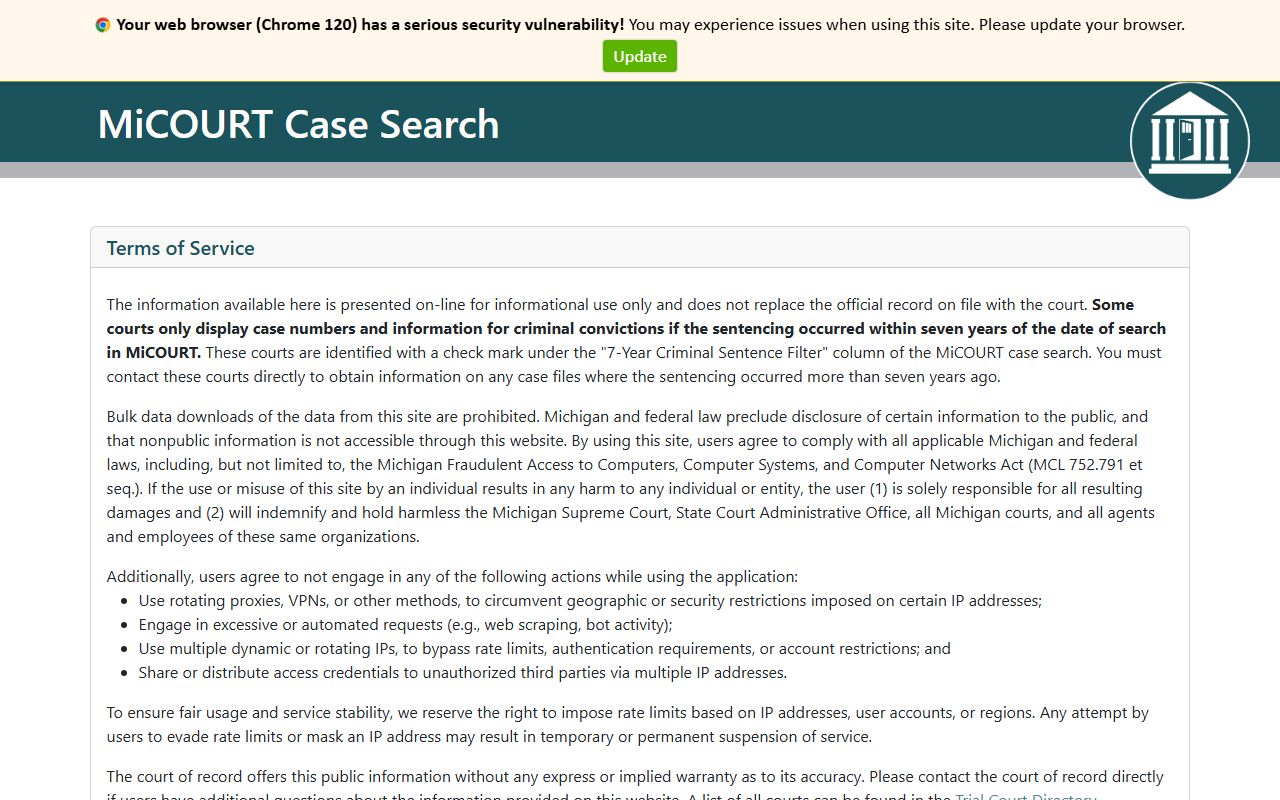
Search results should be checked against the actual court and case type, because booking allegations and filed court charges can differ after prosecutor review.
Oceana County MiCOURT Fields
MiCOURT is built for case lookup, not jail custody lookup. It may show the court, case number, party name, charge or offense, hearing dates, disposition, and fee or fine information when those fields are public. It does not replace VINE for current custody at the Oceana County Jail, and it does not serve as a full statewide criminal-history report.
| Field Label | Type | Required | Format Notes |
|---|---|---|---|
| Court | Dropdown or selector | Yes | Select the Oceana County court or the relevant Michigan court. |
| Search by | Radio button or tab | Yes | Name and case-number options depend on the portal screen. |
| Case number | Text | No | Best when known from court papers, notices, or clerk records. |
| Party name | Text | No | Use defendant last name and first name when searching by name. |
| Date of birth | Date or text | No | Helpful for common names if the interface exposes the field. |
| Case category | Dropdown | No | Criminal, traffic, civil, domestic, and probate availability varies by court. |
| Buttons | Portal control | No | Search, reset, clear, or view-case labels may change as the portal updates. |
Arrest to Arraignment Records
After booking, the first public court events often run through 79th District Court. The court handles arraignments, misdemeanor cases, preliminary examinations, probation, and traffic and non-traffic violations. Arraignment is the first court appearance where rights, charges, plea issues, and release conditions are addressed. For an in-custody defendant, jail and court staff coordinate the appearance logistics.
The official arraignment page gives local process details. People who need to request arraignment by Zoom are told to contact 79th District Court at least 48 hours in advance. The criminal division phone for MiCOURT reminders and arraignment logistics is (231) 873-6718, and signed Advice of Rights forms may be returned to P.O. Box 471, Hart, MI 49420, or districtcourt@oceana.mi.us. Those details matter because a person may have a valid court record even before the public search tools feel complete.
The arraignment image below comes from the Oceana County arraignment page.
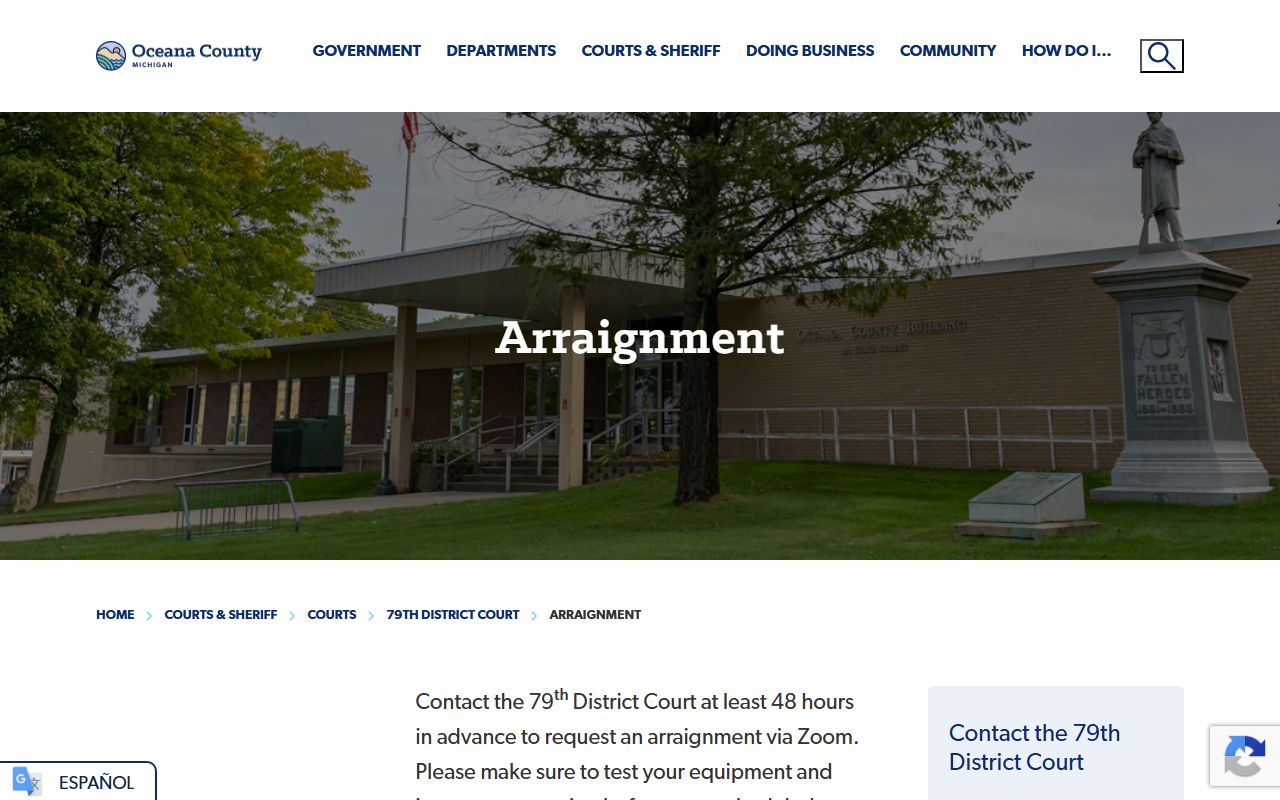
Arraignment records should be read together with bond and custody information, since a release order can be limited by other warrants, holds, or detainers.
Oceana County Arrest Charging Records
Formal charges after a jail arrest are not the same thing as the arrest note used during booking. Law enforcement may submit an allegation or report, then the prosecutor reviews it and authorizes, rejects, amends, or changes charges. Misdemeanor cases may stay in district court. Felony cases begin in district court for early events and move to circuit court only after bindover or waiver.
| Document | Who Uses It | What It Does | Oceana County Context |
|---|---|---|---|
| Complaint | Officer or prosecutor | Starts many criminal cases and states the accusation. | Often tied to arraignment and early district court events. |
| Information | Prosecutor | Sets out formal felony charges in circuit court after bindover or waiver. | Used when a felony moves from 79th District Court to 51st Circuit Court. |
| Indictment | Grand jury | Charges a case through grand-jury action. | Less common in routine local cases, but it is a charging document type. |
For felony matters, a bindover means the district court found or the defendant waived probable cause for the case to proceed in circuit court. The circuit case may then carry a different case number, a different charge list, or new event dates. That is a normal reason a court records after arrest search may need both the district and circuit court paths.
Oceana County Circuit Record Searches
For 51st Circuit Court files, the official record-search page gives a separate written search process. A record search costs $5 per name. Requests must be in writing. If mailed, the request must include a money order and a self-addressed stamped envelope. The court says it provides file numbers, while file viewing or copy work requires coming to the Circuit Court Records Office. The circuit court address is 100 S. State Street, Suite M-10, Hart, MI 49420, with main phone (231) 873-3977.
The circuit record-search screenshot below comes from the Oceana County Circuit Court record-search page.
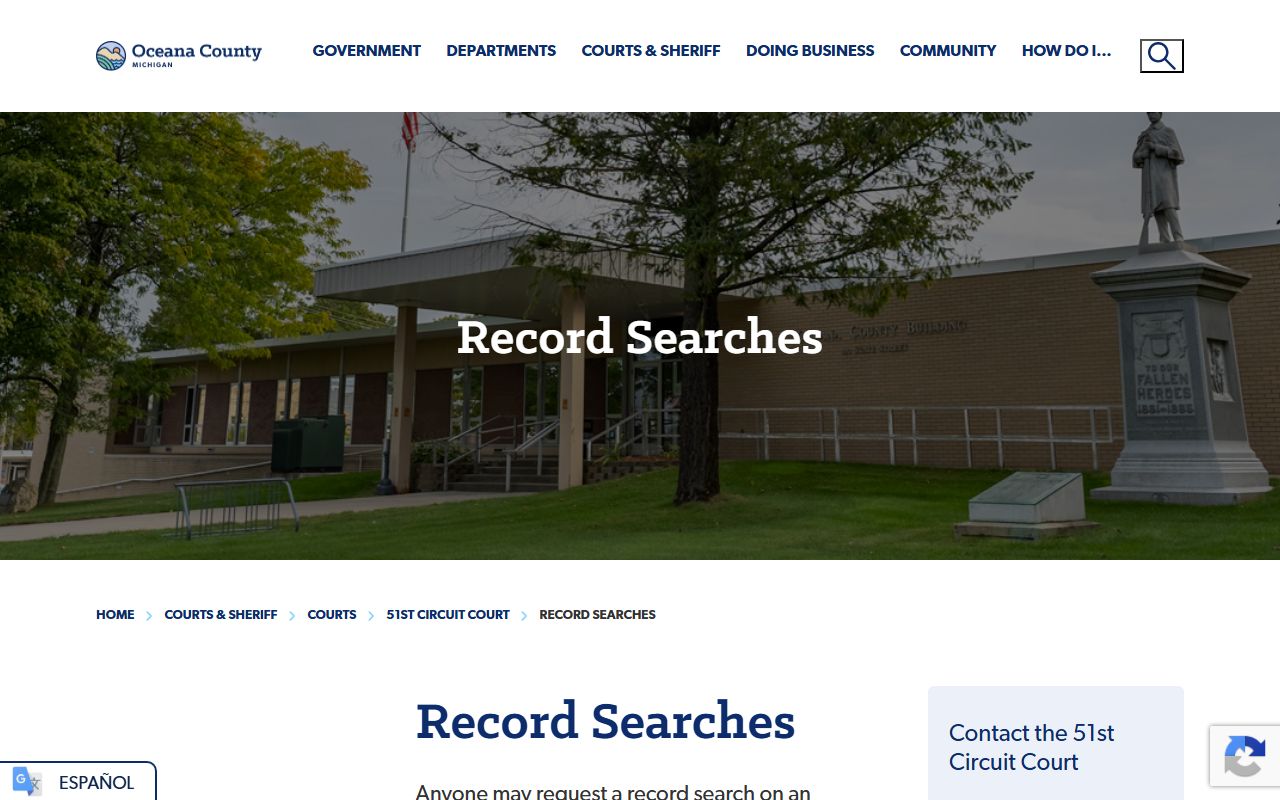
The written search process is especially useful when an online criminal name search is limited by filing year, Clean Slate processing, or public-access restrictions.
Oceana County Charge Status Records
Charge status can change several times after an arrest. The booking allegation may not match the charge filed by the prosecutor, and the filed charge may later be amended, reduced, dismissed, or resolved by plea or trial. Court records are the better source for the formal status because they reflect filed pleadings and docket events rather than intake labels.
| Status | Meaning in Court Records | Why It Matters |
|---|---|---|
| Pending | The case or charge is still open. | Future hearings, bond conditions, or plea talks may still affect the record. |
| Amended | The prosecutor or court changed the charge wording, count, or severity. | The final filed charge may differ from the booking allegation. |
| Reduced | A higher charge was lowered to a lesser offense. | Disposition and sentencing exposure can change. |
| Dismissed | The court ended that charge without a conviction on that count. | Other counts may still remain, so read the full case. |
| Pled or Convicted | The case ended with a plea or verdict on that charge. | The record moves from accusation to conviction status. |
| Set Aside | Eligible Michigan records may be removed from public view under Clean Slate rules. | Older or eligible cases may not show in public name searches. |
Bond Records After Arrest
Bond is set by the court or judicial officer, not by the public roster. Oceana County's inmate information page says bail or bond money can be posted through Express Account online at any time with Visa or Mastercard debit or credit cards, and the county notes that a nominal fee is charged. Payment does not always mean immediate release. A no-bond order, another county warrant, MDOC parole or probation hold, federal hold, ICE detainer, or uncleared court condition can keep someone in custody.
| Bond Type | How It Works | Record Source |
|---|---|---|
| Cash bond | Money is posted directly under court terms. | Court order, jail confirmation, and payment vendor receipt. |
| Surety bond | A licensed bonding agent posts bond for a fee. | Court bond order and bonding paperwork. |
| Personal recognizance | Release is based on a promise to appear and follow conditions. | Arraignment or bond order. |
| Conditional bond | Release includes restrictions such as no contact, testing, travel limits, or reporting. | District or circuit court order. |
| No-bond hold | Release is not authorized until the court or holding agency changes the hold. | Court docket, jail phone confirmation, or holding agency record. |
Warrants in Oceana County Arrest Records
No official Oceana County sheriff active-warrant search page was found in the research sources. The sheriff's public pages list dispatch, jail, civil process, detective, tip, and Silent Observer contacts, but they do not provide a searchable warrant database. Do not treat a third-party warrant page as an official Oceana County court record.
A warrant can still be part of the arrest-to-court path. An arrest warrant is issued after probable cause. A bench warrant is issued by a judge, often for failure to appear or violation of a court order. A search warrant authorizes a search and is not a general public arrest lookup tool while active. A fugitive warrant or hold may come from another county, state, federal, parole, or probation authority.
If the person was arrested and booked at the Oceana County Jail, custody may appear through Michigan VINE or can be checked by calling the jail at (231) 873-3967. Bench-warrant events may appear in MiCOURT, 79th District Court records, or 51st Circuit Court records if public. Executed warrant records or incident reports may require the county FOIA process, while active investigative records may be withheld or redacted under Michigan law.
Charges vs Convictions
An arrest and a charge are accusations. A conviction is a final result reached by plea or verdict. That distinction is critical when reading Oceana County court records after a jail arrest because early case records may list serious allegations that are later reduced, dismissed, or resolved on different counts.
| Point of Comparison | Charge | Conviction |
|---|---|---|
| Stage | Accusation filed in a criminal case. | Final result after plea or verdict. |
| Proof level | Based on probable cause and charging review. | Requires proof beyond a reasonable doubt or a valid plea. |
| Record meaning | Shows what the person was accused of in court. | Shows legal guilt on the count of conviction. |
| Can change? | Yes, by amendment, reduction, dismissal, or added counts. | Can be affected by appeal, set-aside, or other post-judgment action. |
ICHAT and MSP Records
MiCOURT and local court files are case-record tools. Michigan criminal-history checks use separate systems. The 51st Circuit Court page points users to ICHAT, the Michigan State Police online name-based criminal-history search, and notes a $10 payment per search at checkout. ICHAT is name-based, so common names, aliases, and date-of-birth issues can affect matching.
Michigan State Police also offers a fingerprint-based personal records check. The research notes a $30 processing fee for that fingerprint route, and it can include public and nonpublic criminal history tied to the submitted prints. That is different from checking whether someone is currently in jail, different from a written circuit court search, and different from using MiCOURT to track a specific Oceana County case.
Important: Oceana County Inmate Population is not a consumer reporting agency under the FCRA, and records cannot be used for FCRA-covered decisions.
Sealed and Expunged Records
Michigan Clean Slate rules can affect what appears in public court searches. The 51st Circuit Court page specifically notes that older online criminal name-search access was discontinued while records affected by Public Act 193 of 2020 were updated. That means an older case may need a written court search, clerk review, or may no longer be visible in a public name search.
| Point of Comparison | Sealed or Nonpublic | Expunged or Set Aside |
|---|---|---|
| Public visibility | Hidden or restricted from normal public view. | Removed from public criminal-history view when legally set aside. |
| Agency access | Some courts or law-enforcement agencies may still have limited access. | Access depends on Michigan set-aside law and the record type. |
| How it affects search | MiCOURT or name search may not display the record. | Public ICHAT or court searches may no longer show the conviction. |
| What to verify | Ask the court that controls the file. | Confirm with the court or MSP process tied to the record. |
Juvenile matters, sealed charges, dismissed charges affected by public-access rules, and active investigative records can have different limits. The safest reading is narrow: if a public search does not show a record, use the court clerk or the proper Michigan State Police process before drawing a conclusion.